 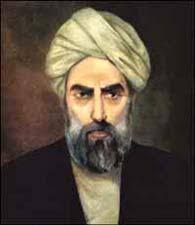
Muhammad ibn Ibrāhim
al-Qawāmī al-Shīrazī = Ṣadr al-Dīn Shīrazī
= Mullā Ṣadrā
(born Shiraz
c. 979/ 1572 - died Baṣra 1050 /1641 CE)
IN PROGRESS 2009-10
Dr. Stephen Lambden (UC-Merced)
Ṣadr al-Din Shirazi = Muhammad ibn Ibrahim
al-Qawāmī al-Shīrazī (d.1050/1641)
al-Asfar "The Four Journeys"

al-Asfar = al-Hikma al-Muta'aliyya
fi'l-Asfār al֊ Arba'a ("The Transcendental Wisdom respecting
the Four Journeys")
- al-Aṣfar al-Arba`ah / al-Ḥikmah al-Muta`āliyya],
2 vols. Glosses by Muhammad Ṣādiq al-Gulpāygānī, Rajab
1282/1865. Persian Lithograph printed by Mullā `Ali
Dāmghānī, c. 1282/1865-6. See Brockelmann GAL Supp. II:
588; Gacek, 1996, No. 12 p.17.
- al-Hikma al-Muta'aliya
fi'l-Asfār al֊ Arba'a. 9 vols. Qum: al-'Ilmiyya, n.d.
al-Ḥikma al-muta'āliya fi-'l-asfār al-'aqliyya
al-arba'a.
ed. R. Lutfi et al., Tehran and Qum: Shirkat Dar al-Ma'arif
al-Islamiyyah, 9 vols. 1958-69?.
- al-Ḥikma al-muta'āliya fi-'l-asfar al-'aqliyya
al-arba'a vol. 1, 2nd printing, with introduction
by Muhammad Rida al-Muzaffar, Qum: Shirkat Dar al-Ma'arif al-Islamiyyah,
1967.
- al-Ḥikma al-muta'āliya fi-'l-asfār al-'aqliyya
al-arba'a, ed. By Muhammad Riḍā al-Muzaffar, 9 vols.
Beirut: Dār Iḥyā’ al-Turāth al-’Arabī,
3rd printing, [1401] 1981.
*
- al-Ḥikma al-muta'āliya fi-'l-asfār al-'aqliyya
al-arba'a, ed. By Muhammad Riḍā al-Muzaffar, 9 vols.
Beirut: Dār Iḥyā’ al-Turāth al-’Arabī, 14XX/ 1990.
- al-Asfar al-Aqliyah fi al-Asfar al-Aqliyah
al-Arba'ah. ed. Ridha Lutfi; Introd. Muhammad Ridha
al-Mudhafar 9 vols. Beirut: Dar Ihya al-Turath al-Arabi:
includes the commentaries of al-Sabzawari, al-Tabatabai, al-Mudaris,
al-Hadaji, and al-Isfahani...
- Spiritual Psychology: Asfar v. VIII & IX: The
Fourth Intellectual Journey in Transcendent Philosophy by Mulla
Sadra Shirazi. Islamic College for Advanced Studies
Publications. 747pp. ISBN-10: 1904063322 ISBN-13: 978-1904063322
2008.
-
"This multi-disciplinary and
inter-disciplinary work presents the rethinking of the entire
tradition of Islamic philosophical psychology by Mulla Sadra on
the most profound questions and issues pertaining to the soul.
It includes the views of the ancient Greek philosophers and
physicians, Muslim philosophers, theologians, Sufis,
theosophists and physicians, the teachings of the Qur'an, the
Traditions of the Prophets and the Shiite Imams, and Mulla
Sadra's own profound insights and intellectual elucidations
combined with impeccable logical proofs and demonstration. It
deals with the definition of the soul, the proof of its
existence, its birth as corporeal and its survival as spiritual,
various levels of the soul and the body, the vertical
development of the soul through its substantial motion, the
soul-body relation, the holistic approach to psychosomatic
diseases, the resurrection and post-mortem survival of the soul,
the body of the resurrection, his original interpretation of
metempsychosis, the meaning of Heaven and Hell and the
intellectual or spiritual worlds beyond this world. The central
issue in this work is self-knowledge. The human soul is created
in the Image of God with a purpose. This image comes to full
actualisation through self-knowledge, which according to Mulla
Sadra is the key to knowledge of God, the Day of Resurrection
and the Return of all creatures to God." (Publisher's product
description).
Kitāb al-Ḥikma al-'arshiyya
(The Wisdom of the Throne)
-
Early editions include, Mullā Sadrā, al-Ḥikma
al-`arshiyya on pp. 110-214 of the composite Mulla Sadra lithograph
of 1315/1897-8 which also includes the Mashā'ir with other commentaries.
-
al-Ḥikma al-'arshiyya (The Wisdom of
the Throne), ed. with Persian paraphrase by Ghulām Riḍā Āhānī's, Isfahan, 1962
-
Kitāb al-`Arshiyya. Beirut:
Mu`assasat al-Tarikh al-`Arabi [= The Arabic History Est.]
1420/2000 (104pp.).
*
-
The Wisdom
of the Throne: An Introduction to the Philosophy of Mullā
Sadra. Trans. James Winstron Morris. Princeton Library of Asian
Translations. Princeton: Princeton University Press, 1981.
*
-
Trans. and intro. J. W. Morris, The
Wisdom of the Throne: An Introduction to the Philosophy of Mulla Sadra,
Princeton, N.J: Princeton University Press, 1982.
-
Shaykh Aḥmad al-Ahsā'ī
(d.1241/1826).

-
شرح الكتاب
الحكمة العرشية
Sharḥ al-kitāb al-ḥikmat al-`arshiyya ("Commentary
upon the Book of the Wisdom of the Throne"). Lithograph 1st ed. in 2
vols. Vol.1 [Tabriz: ADD] 1271/ 1854-5 and vol.2 [Tabriz: ADD,
1278-9/1861-2.
This work is a commentary by Shaykh Aḥmad upon the Kitāb al-ḥikma
al-`arshiyya ("The Book of the Wisdom of the Throne") by Muhammad
Sadra al-Dīn Muhammad b. Ibrahim al-Shirazi, known as Mullā
Sadrā (d. 1050/1640). This 100 or so page work of Mullā
Sadrā with the title Kitāb al-`arshiyya (The Book of the
Throne) has recently, in 1429/2000 (1st printing) been printed in
Beirut by the Mu'asassa al-Tārīkh al-`Arabiyya ("The Arab History
Estate").
A useful approach to this work is the
English volume of James W. Morris (trans.), The Wisdom of the Throne, An
Introduction to the Philosophy of Mulla Sadra. Princeton: Princeton
University Press, 1981. Aside from containing an excellent introduction
to the work of Mullā Muhammadadrā and to his Kitāb al-`Arshiyya, this
volume provides an annotated translation of the Kitāb al-`arshiyya with
occasional comments upon Shaykh Aḥmad's critique (esp. pp.47f; 126n.67).
Morris' translation is based upon Ghulām Riḍā Āhānī's Arabic edition of
the al-Ḥikma al-`arshiyya (with Persian paraphrase, Isfahan, 1341 Sh./
1962, pp. 218-288) occasionally corrected on the basis of reference to
the lithograph edition of Shaykh Aḥmad's commentary upon the `Arshiyya
(lithographed in 1278/1861, see above).
-
شرح العرشية
later
editions.
-
A 2nd (3rd?) edition of Shaykh
Ahmad's commentary in two volumes entitled Sharḥ al-`Arshiyya was
printed at the Shaykhī press in Kerman: Kirmān: Maṭba`at al-Sa`ada,
vol.1 1361 Sh / 1983 and vol. 2 1363/1985. In this second edition volume
1 has 5 indexes spanning eighty pages and the commentary from p. 2 until
p. 332 (K-`Arshiyya), while volume 2 again has several indexes and the
commentary on pp. 4-335 (K-`Arshiyya). Some glosses on Shaykh Ahmad's
commentary by Karim Khan Kirmani are also printed (in vol.2 = pp.
336-367).
-
This 2nd or 3rd (?) edition of Shaykh Ahmad's commentary in 3
vols. [sic. ?] entitled Sharḥ al-`Arshiyya fi al-mabda` wa'l-ma`ad is
said to have been printed at the Shaykhī press : Kerman: Matba`at al-Sa`ada,
in 1405-6/ 1985-6 (so Ihqaqi, al-Tahqiq, 261).
-
-

Moris, Zailan.
Revelation, Intellectual Intuition and Reason in the Philosophy of
Mulla Sadra: An Analysis of the Al-Hikmah Al-'Arshiyyah. Rep.
Routledge: 2003. 240pp. ISBN-10: 0700715029 ISBN-13:
978-0700715022 = "An examination and analysis of the legitimacy of the widely-held
claim that Mulla Sadra's philosophy is a synthesis of principles and
doctrines drawn from revelation, gnosis and discursive philosophy.
It demonstrates how Mulla Sadra achieves this synthesis in his
"Wisdom from the Divine Throne".
-
From the Back Cover
"Many Islamic philosophers and scholars of Islamic Philosophy
consider Mulla Sadra's (1572- 1641) philosophy to be a synthesis
of principles and doctrines drawn from revelation (wahy), gnosis
or illuminative knowledge ('irfan/ma'rifah) and discursive
philosophy (al-hikmah al- bathiyyah). This book investigates
whether there is such a synthesis in Mulla Sadra's philosophy,
how this synthesis is effected and finally whether it is
successful. The examination and demonstration of Mulla Sadra's
synthesising method is mainly based on his book al-Hikmah al-'arshiyyah
or Wisdom from the Divine Throne. The book bases the evaluation
of his success on the internal coherence of his ideas, their
conformity to Islamic religious teachings and their impact on
the Islamic thinkers after him. The question of reconciling and
synthesising the three sources of knowledge to create a coherent
and articulate philosophical perspective is of great import and
significance not only in Islamic philosophy but also in the
field of philosophical enquiry generally. His method of dealing
with these three sources of knowledge discloses new insights,
brings new understanding and suggests a new manner of
approaching them. Although, both Islamic and western Philosophy
share a common heritage in ancient Greek philosophy, they have
taken diverse courses of development since the European Middle
Ages. This divergence is due in part to their radically
different treatments of the fundamental sources of knowledge
available to man. In the west, especially since the Renaissance,
reason and sense experience began to play an almost exclusive
role in man's quest after true and certain knowledge. In the
Islamic world, reason became more and more aligned with
intellectual intuition and both were made subordinate to
revelation. The examination of Mulla Sadra's synthesis discloses
the epistemological orientation of a major Islamic philosopher
who was a contemporary of Descartes. Thus, it offers a basis for
the understanding of the diverse epistemological perspectives of
the Islamic and Western philosophers since Ibn Rushd or Averroes
in the twelfth century."
-
Kitāb al-mashā'ir
(The Book of the Metaphysical Insights)

-
Kitab al-masha'ir (The Book of
Metaphysical Penetrations), ed., trans. and intro. by H. Corbin, Le
livre des pénétrations métaphysiques, Paris: Départment d'Iranologie de
l'Institut Franco-Iranien de Recherche, and Tehran: Librairie d'Amerique
et d'Orient Adrien-Maisonneuve, Bibliothèque Iranienne vol. 10, 1964 +
1982 + French portion re-edited Lagrasse: Verdier, 1988; ed. and trans.
P. Morewedge, The Metaphysics of Mulla Sadra, New York: Society for the
Study of Islamic Philosophy and Science, 1992.
-
-
Kitāb al-mashā'ir. ed. and trans.
Henri Corbin, Live des pénétrationes Métaphysiques. Tehran + Paris,
1964; also rep. 1982 = Tehran: Institut Francais d'Iranologie de
Tehran [1968] + Paris: Librarie d'Amérique et d'Orient, A.
Maisonneuve, rep. 1982 Kitāb-khānih: Tahūrī (= Bibliotheque
Iranienne, Vol. 10). Contents in 1982 repr. = Ar. section, K.
Mashā`ir pp. 1-81; Per. trans. pp.84-220; French section. I. Intro.
Biog. of Mullā Muhammadadrā, 1-26; Ch. II = Bibiographical essay re:
Mullā Muhammad Sadr, pp. 27-41. Ch. III = Kitāb al-Mashā`ir, +Ar. and
Per. commentaries, pp.42-52 includes refs. to Shaykh Aḥmad's comm,
pp. 47-50. etc. Corbin's French trans + notes, spans pp.87-242. The
French index records extensive refs. to Shaykh Aḥmad's comm (for the
list see p. 243).
*
 
-
The
metaphysics of Mullā Sadrā : Kitāb al-Mashāʼir = The book of
metaphysical prehensions by Muḥammad ibn Ibrāhīm Ṣadr al-Dīn
Shīrāzī; Parviz Morewedge; Henry Corbin; Society for the
Study of Islamic Philosophy and Science.; Institute for Cultural
Studies. New York City: SSIPS, 1992. ISBN: 0963327712
9780963327710
-
- Molla Sadra Shirazi, Le Live des Pénétrationes
Métaphysiques (Kitāb al-Mashā`ir) Ed. + trans.etc. Henri Corbin.
Editiones Verdier, 1988 (ISBN 2-86432-070-3). The above volume is a
reprint of the 1964 French introduction (pp.1-78) and translation
(pp. 81-164) with extensive notes (pp.166-234) + index (pp.
235-232), etc..
- Lahijani, M. J., Commentary on the Recital of
Mashā`ir. ed. + notes, J. Ashtiyani (Mashhad, 1965).

- 1992 Parwiz Morewedge (trans.), The Metaphysics of
Mulla Sadra. Kitāb al-Mashā`ir, The Book of [Metaphysical]
Prehensions (Islamic Philosophy Translation Series = ISPTS) The
Institute for Cultural Studies, Tehran Iran. Sponsors = The Society
for the Study of Islamic Philosophy and Science [SSIPS]. New York,
1992 (ISBN 0-9633277-1-2). This is a translation from the Corbin
edition (with occasional corrections and notes); the Arabic and its
English translation face each other from page 1-88 (Ar.+ Eng.
beginning). Notes are included from p.89ff.
- Muhammad Sadr al-Dīn Muhammad al-Shirazi, Mullā
Sadrā Shirazi, Kitāb al-Mashā`ir . Introd. Henry Corbin
(Arabic trans.). Beirut: The Arabic History Est. / Mu`assat al-Tarikh
al-`Arabi. 1420/2000. 128pp. (incl. introd. and index).
- Fakhr al-Din al-Razi
(d. 606/1209 ), al-Risālat al-Kamāliyya fi'l-ḥaqā'iq al-ilāhiyya.
Beirut: Dar al-Kutub al-`Ilmiyya, 1324/2002. (97pp. + Mulla
Sadra's Kitab al-Masha'ir = pp.99-142 + index pp.143-4). The
Kitab al-Masha'ir of Mulla Sadra is printed in this slim
paperback volume.
- Kitāb al-mashā'ir.
Beirut: Dar al-Ihya al-Turath al-`Arabi, 2000+2003.
Tafsir writings

Asrar al-āyat ("The
Mysteries of the Verses")
- Asrar al-āyat Commentary by Ali al-Nuri
Beirut : Mu'asasat al-Tarikh al-Arabi: ADD 600pp.
-
Asrār
al- Āyāt fī tafsīr al-Qurān li-Muhammad al-Ma`ruf
bi-Sadr al-Muta`alihin al-Shirazi. Tehran" Hajji Muhammad Ahmad Shirazi,
Ramadan 1319/ ADD.
-
Tafsīr al-Qur'ān al-Karimli-Sadr
al-Din Shirazi bi-Sadr al-Muta`alihin
Muhammad ibn Ibrahim al-Shirazi. Tehran: Shaykh Ahmad Shirazi,
1320-1322 AH/ XXXX-XXXX.
-
-
Tafsir Sūrat al-A`lā. in margins of a
Persian Lithograph (pp.270-296) of the Risala fi ajwibat al-su`ālāt al-muta`allqa
bi'l-ma`ārif by `Alī al-Nūrī and printed with Kashf al-fawā'id
etc., see Tehrani, al-Dhari`a, 4:1445. Gacek ALB No. 364 p.202.
- Tafsīr Sadra, Shľrazi [= Tafsīr al-Fātiha;
Tafsīr al-Baqara; Tafsīr Āyat al-Kursī] Lithograph ADD
1322 [1914].
- Tafsīr al-Qur'an al-Karim. ed. Muhammad Khājavī,
7 vols. Qumm: Intishārāt Baydār, n.d. [199?].*
- Asrār al-āyat, edited with prolegomena and notes by
Muhammad Khājavī Tehran : ADD , 1360/ 1981.
- Tafsīr Sūrat al-Wāqi'a (=Q. 56), n.p. n.d.
- Tafsir Sūrah-yi Wāqi'a (=Q. 56), ed. and
Persian trans. Muhammad Khājavī , Tehran: Intisharat Mawla,
1363/ 1984 + 2nd ed. 1377=1419/1998.
*
- Tafsir Sūrahha-yi Ṭāriq [Q. ] va
A`la [Q. ]va Zalzal [Q. ].. Ed. and
Persian trans. Muhammad Khājavī , Tehran: Intisharat Mawla,
1363/ 1984 + 2nd ed. 1377=1419/1998
*
- Tafsir Āyah-yi Nūr [Q. 24:35]. Ed and Persian trans.
Muhammad Khājavī , Tehran: Intisharat Mawla, 1362/1983 + 2nd
ed. 1377=1419/1998.
*
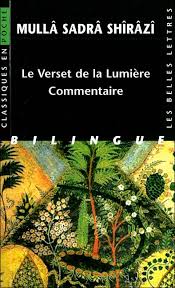
- Le verset de la
lumière : Commentaire.. trans. Christian Jambet (Classiques En
Poche). [Paris] Belles Lettres, 2009. 135pp. ISBN-10: 2251800034
ISBN-13: 978-2251800035.
- Tafsir Sūrah-yi Jam`ah.
ed. and Persian trans.
Muhammad Khājavī , Tehran: Intisharat Mawla, 1363/1984 =
1404/1983
*
- Mutashābihāt al-Qur'ãn in idem, Three treatises...
Ed. with an introduction and notes by Sayyid Jalāl al-Dīn Āshtiyānī,
English preface by Seyyed Hossein Nasr, Mashhad 1392/ 1973, pp. 75-121.
- Majmū`a Rasā'il Falsafī Ṣadr al-Mutā'alihīn.
ed. Hamiz Naji Isfahani, Tehran: Intisharat-i Hikmat, 1375
Sh. / 1996
*
(624pp.)
This compilation contains two Tafsir works of Mulla Sadra: Tafsir Surat
al-Tawhid I (Item 15 pp.393-439) and Tafsir Surat al-Tawhid II (Item 16
pp.441-449).
- Asrar al-Ayat (The Mysteries of the Qur'anic Verses).
Persian trans and annotation Muhammad Khājavī (=
Cultural Studies Research Institute, The Islamic Iranian Academy of
Philosophy Pub. No. 533), Mu`asassah-yi Muta`aliat va Tahqiqat
Farhangi Tehran: Intisharat Mawla, 1363=1405/ 1984
*

- Risalah-yi ḥuduth al-`ālam ya Kitab-i Afrinish-i
Jihan. Ed and Persian trans. Muhammad Khājavī
, Tehran: Intisharat Mawla, 1363/1405 + 2nd ed. 1377=1419/1998.
*
- Majmū`at al-Rasā'il.
Qum: Manshurat Maktabat Ayat-Allah al-Mara`shi al-Najafi.
1404/1983.
*
Contains works of (1) `Allamah al-Ḥllī , Kashf al-Fawa'id
(2) Shahid al-Thani, Asrar al-Salat (3) Shahid al-Thani,
Kashf al-Rība (4) Mulla
Sadra, Tafsir Surat al-A`la and (5) Ma`ani ba`aḍi al-akhbār
li'l-Saduq (= Ibn Babawayh al-Qummi).
- Risalah-yi ḥash. ed and
Persian trans. Muhammad Khājavī , Tehran: Intisharat Mawla,
1363/XXXX
*
+ 2nd ed. 1377=1419/1998*
- Lawāmi` al-`ārifin fi aḥwāl Ṣadr al-mutā'lihīn... (Mullā
Sadrā), Muhammad Khājavī , Tehran: Intisharat Mawla, 1366=1408
/1987*
- Majmu`ah-yi Afsh`ār-i Faylasuf-i Kabir Ṣadr al-Din Shirazi
(Mulla Sadra). ed. and introd. Muhammad Khājavī , Tehran:
Intisharat Mawla, 1376/1418.
*
A Compilation of Persian Poetry
of Mulla Sadra.
- Risalah-yi sih aṣl taṣnif Sadr al-Din, Muhammad ibn
Ibrahim Shirazi (Mulla Sadra). introd. Dr.
Sayyid Hosseyn Nasr + ed. Muhammad Riḍā Jawzī, Tehran: Intisharat -i
Ruzhah , 1377/1998.
*
Includes a Mathnavi of Mulla Sadra (pp. 117-132)
and some Quatrains (pp. 133-4).
- On the Hermeneutics
of the Light Verse of the Qur'an (Tafsir Ayat al-Nur),
translated, introduced and annotated by Latimah-Parvin Peerwani,
ICAS Press, 2004. (167pp.).
Ashtiyānī, Jalāl al-Dīn (ed.)
-
Consciousness and reality
: studies in memory of Toshihiko Izutsu (=Islamic philosophy,
theology, and science, v. 38.), Leiden: Brill, 2000. Includes:
Islamic resurgence,
Al-Wāqidī, the orientalists and apologetics --
The Quranic commentaries of Mullā Ṣadrā
...
 
Sharh Usūl
al-Kafi
("Commentary upon the Usūl al-Kafi [of Kulaynī])
-
Sharh
Usūl al-Kafi (Kitab al-Tawhid). vol.1 ed. Muhammad Khājavī , Tehran:
Mu`assasah Matali`at Tahqiqat Farhangi, 1370/ ADD.
-
Sharh
Usūl al-Kafi (Kitab al-`aql wa'l-Jahl). vol.2 ed. Muhammad Khājavī , Tehran:
Mu`assasah Matali`at Tahqiqat Farhangi, 1366/ ADD.
-
Sharh
Usūl al-Kafi (Kitab Fadl al-`Ilm wa Kitab al-Hujja). vol.
3 ed. Muhammad Khājavī , Tehran: Mu`assasah Matali`at
Tahqiqat Farhangi, 1367/ ADD.*
-
-
Sharh
Usūl al-Kafi ed. Muhammad
Khamanai', 4 vols. Tehran (?) : Intisharat Banyad Marif
Islami, 200?
-
Sharh
Usūl al-Kafi ed. Muhammad
Khājavī,
4 vols. Tehran (?) : Intisharat Banyad Marif
Islami, 200?

al-Shawāhid al-rubūbiyya
("The Lordly Witnesses)
-
al-Shawāhid al-rubūbiyya
("Divine Witnesses") li-Muhammad al-shahir bi-Ṣadr al-Din Shirazi,
Hashiyya al-Hadi ibn Mihdi Sabzawari. Lithograph calligraphed by
Muhammad `Ali Isfanahi, Tehran, Safar 1286/18XX., 264pp.
-
-
al-Shawāhid al-rubūbiyya
("Divine Witnesses") Ṣadr al-Din Shirazi
(Mulla Sadra) with the complete glosses of Hajji Mulla Hadi Sabzawari,
Ed with Introduction and Notes by Seyyed Jalal al-Din Āshtiyānī
(Professor of the Faculty of Theology), Meshed University Press, 1st ed.
Mashad: Intisharat Daneshgah Mashad, 1346 Sh./ 1967
-
-
al-Shawāhid al-rubūbiyya Ṣadr al-Din Shirazi
(Mulla Sadra) with glosses of Hajji Mulla Hadi Sabzawari,
Ed with Introduction and Notes by Seyyed Jalal al-Din Āshtiyānī
(Professor of the Faculty of Theology), 910 pp.
-
-
al-Shawāhid al-rububiyyah fi
manahij al-sulukiyyah, ed. by Sayyid Jalal al-Din Ashtiyani in 2
volumes together with Sabziwari’s commentary
2nd ed. Mashhad: Chapkhanih Daneshgah, 1360Sh. /1981. 832pp. *
Mafātīḥ al-ghayb (The
Keys of
the Unseen)
-
Mafātīḥ al-ghayb lil-Ḥakim al-ilahi
wa'l-Faylasuf al-Rabbani Ṣadr al-Dīn Muhammad ibn Ibrahim Shīrazī
(Ṣadrā al-Muta'alihin)... Beirut: Mu`assa al-Tarikh
al-`Arabi, 3rd ed. 1424/2003. (2 vols. in 1, 898 pp.).*
-
Tarjana
Mafātīḥ al-ghayb ed and Persian trans. Muhammad Khājavī , Tehran: Intisharat Mawla,
1363=1404/1983.+1371/1414/1992. (1099pp.)*
al-Maẓāhir
al-ilāhiyya ("The Divine Disclosures regarding the Secret
of the Sciences [leading to] Perfection")
- al-Maẓāhir al-ilāhiyya
fī asrār al-‘ulūm al-kamāliyya , ed.+ Introduced Sayyid Muhammad Khamanei.
Tehran: Bunyad-i Hikmat-i Islami-yi Sadra, 1378/XXXX.
370pp [= Extended Persian introduction by Sayyid Muhammad
Khamanei] + Text of the Mazahir...in 153pp. + Indexes (= pp.
155-188).
*
Iksīr al-`Arifin (The Elixir of
the Gnostics)

- Mulla Sadra. The Elixir of the Gnostics, A
parallel English-Arabic text translated, introduced, and
annotated by William C. Chittick. Provo, Utah: Brigham
Young University Press, 2003 (145+ 87 [Arabic] pp.*
"Sadr ai-Din Muhammad Shīrāzī, more commonly
called Mullā Sadra (1572-1640), was one of the grand scholars of
the later period of Islamic philosophy and has become one of the
best known Muslim philosophers. Originally composed in Arabic,
Iksir al-'arifin, or Elixir of the Gnostics, may well be unique
among Sadrā's writings because it reworks and elaborates on an
earlier work in Persian, the Jãwidãn-nãma (The Book of the
Everlasting) by Afdal al-Din Kāshāni, commonly known as Baba
Af'dal.
The underlying theme of Elixir is a teaching that stands at the
heart of Mullā Sadrā's writings and those of many other Muslim
thinkers: the importance of՝ self-knowledge in each person's
journey of "Origin and Return." Each soul originates with God,
and one's journey is completed only when the soul has returned
to Him. Self-knowledge is the means by which the soul, having
been created in the divine image, must realize its full and
final potential; and philosophy, in Sadrā's view, is the most
direct path to that end. Sadra sees the soul's climb to
perfection as a gradual disengagement from all embodiment and
materiality and a return to her transcendent essence. The
returning soul comes to see that all realities and essences are
found in the Intellect from which all things have descended, and
that their corporeal appearance is a temporan,՛ affair.
In Sadrā's way of looking at things, everything in existence is
traveling on a path that ends up at its rightful place with God.
The movement of all creation on the path of Origin and Return,
or from First to Last, is a great manifestation of God's wisdom
and compassion, culminating in a state of permanent happiness
for all creatures." (text from Dust Jacket)
Khalil, A.
- Mulla Sadra, The Elixir of the Gnostics: A
Parallel English-Arabic text (by William Chittick trans.).
American Journal of Islamic Social Sciences vol. 21/pt. 1
(2004), 360-362
 
al-Mabda' wa'l-Ma`ād ("The Book
of the Origin and the Return")
- al-Mabda' wa'l-Ma`ād ed. Jalaluldin
Ashtiayni, ADD HERE 650pp.
- ADD
- al-Mabda' wa'l-Ma`ād ("The Book
of the Origin and the Return"), 2nd ed. Beirut: Dar al-Hādī,
1426/2005 (648pp.).*

Risala al-huduth ("The
Treatise on the Generation")
- Risala al-huduth. ed. Sayyd Husayn Musawiyyan.
Tehran : Banyad Hikmat Islami, XXXX 420pp.
Ajwabat al-masail & Qutb
wa'l-mantiqah ("Treatise on the Poles
and the Zodiac")
- Ajwabat al-masail & Qutb wal mantiqah
ws. Hassan Hassanzadeh Amoli & Dr. Abdulla Shakiba, 1999
(?) 275pp. ISBN: 964-92244-2-4
Glosses on Suhrawardi'a Hikmat
al-Ishraq.
Commentary on Avicenna's Shifa...
etc
- ADD
- Ta'liqah 'ala Ilahiyat al-Shifa. 2
vols. Ed. Najaf Quli Habibi, ADD Tehran: Intisharat Banyad
Sadra. 1200 pp. *
Kitab al-Hujja (The Book of the
Proof).
- Kitab al-Ḥujja. Beirut: Mu`assah al-Tarikh
al-`Arabi [Dār al-Turath], 1425/2004 (227pp.).*
Rasā’il Falsafi
(Philosophical Trestises)
- Rasa’il Falsafi,
ed. S. J. Ashtiyani. Qum: Markaz-i Intisharat Daftar-i Tablighat-i
Islami, 1362? ADD.
Rasā’il
Mulla Sadra (Treatises of Mulla Sadra)

- ADD
- Rasā’il Mulla Sadra , Beirut: Dar al-Ihya al-Turath
al-`Arabi, ADD., 512pp.
- ADD

- Rislalatān fi al-tasawir wa'l-tasdiq - by al-Qutb
al-Din al-Razi al-Tahtani (d. 766/1364) + Sadr al-Din al-Shirazi
(d.1045/XXXX) + ed. Mahdi Shari'ati 450 pp. Beirut: Dar
al-Kutub al-`Ilmiyya, ...
includes Sharh al-Risala al-ma'mula by Muhammad Zahid al-Hurawi
(d. 1101/ADD, a commentary on the Risala of al-Razi (= al-Tasawir
wa'l-tasdiq) ed by Mahdi Sariqi. 129+321pp. *
Kasr
asnam al-jahiliyya fi al-radd `ala al-Sufiyya ("The Smashing of the
Idols of Ignorance in refutation of the Sufis")

- Kasir asnam al-Jahileyah fi'l-radd `ala
al-Sufiyya . ed. Husayn al-Taqsh, Beirut: Ma'had al-Marif al-Hikmiyah,
ADD... 189pp.*

- Breaking the Idols of Ignorance : Admonition
of the Soi-Disant Sufi [Sadr al-Din Shirazi (Mulla Sadra)]
140x215mm, October 2008; 1904063276:9781904063278 , ICAS Press
(Islamic College for Advanced Studies)" 162pp.
-
"This work marks the meeting point of three
different traditions of the Shi'i-Islamic thought:
philosophical, mystical, and theological. In this book, Mulla
Sadra masterfully analyses the creed of false mystics and those
groups of philosophers whom he named as disgraceful impious
sophists. The work deals with the most crucial issues of
metaphysics, encompassing ontology, cosmology, epistemology,
psychology and spiritual wayfaring, the attributes of the pious,
and some homiletic advice. It stresses the importance of virtue
and spiritual exercises on the true Sufi path while presenting
Mulla Sadra's own metaphysical commentary inspired by the Holy
Qur'an."
Other Books
- Rasā'il fi al-taṣawwur wa'l-taṣdīq
by Quṭb al-Razi (d.766) and Ṣadr al-Shirazi (d.1054)
ed. Mahdī Sarba`nī (Pt.1 = al-Qutb al-Razi pp.1-146
+Pt. II pp.1-149 = Mulla Sadra) and (Pt. III) Muhammad
Zāhid ibn Muhammad Islam al-Husayni al-Harawi, Sharḥ
Risālah al-Ma`mūliyya fi al-taṣawwur wa'l-taṣdīq (= Pt.
III pp. 1-292 + index) Beirut: Dar al-Kutub
al-`Ilmiyya, 1425/2004.
GENERAL : SADR AL-DIN
SHIRAZI
URLs.
http://www.muslimphilosophy.com/ip/rep/H027.htm
COMPILATIONS, PROCEEDINGS... WORLD CONGRESS
The Sadra
Islamic Philosophy Research Institute (SIPRIn) was
established in 1994 with the aim of holding the World Congress on
Mulla Sadra, introducing Mulla Sadra and his famous school of
thought; the Transcendent Philosophy, and contacting the main world
philosophical centers. Sadra Islamic Philosophy Research Institute.
Imam Khomeini Complex, Resalat Exp., Building #12, Tehran, Iran.
E-Mail: Mullasadra@DPImail.net , Telephone : 021-88734685 ,
021-88734686 , 021-88734689 , Fax: 021-88831817
-
Mulla
Sadra and Comparative Studies - Islam-West Philosophical
Dialogue. Papers of the World Congress on Mulla Sadra, Tehran,
May 1999.
-
Volumes 1 & 2, SIPRIn. 2001. by 1999 papers MULLA SADRA CONGRESS
, 2001.
 
-
The Sadra Islamic Philosophy Research
Institute (SIPRIn), Volumes 3 & 4, SIPRIn. 2002. = 1999
papers of the Mulla Sadra Congress, 2002.
-
Mulla
Sadra and Comparative Studies. The Papers Presented at the World
Congress on Mulla Sadra (May 1999, Tehran) Volume 4 by
The Sadra Islamic Philosophy Research
Institute (SIPRIn), 2002.
__________________
'Abdul Haq,
M.,
-
"An
Aspect of the Metaphysics of Mullā Sadra", Islamic Studies, vol.
9, 1970, pp. 331-53.
-
"The
Metaphysics of Mullā Sadra II", Islamic Studies, vol. 10, 1971,
pp. 291-317.
-
"Mullā
Sadra's Concept of Being", Islamic Studies, vol. 6, 1967, pp.
268-76.
-
"The
Psychology of Mullā Sadra", Islamic Studies, vol. 9, 1970, pp.
173-81.
Açıkgenç, Alparslan,
- Being and Existence
in Sadra and Heidegger, Kuala Lumpur: I.S.T.A.C., 1993.
‘Alawi, Hadi,
- Nazariyyat al-Harakah
al-Jawhariyyah ‘ind al-Shirazi, (Beirut: 1983).
Akbarian, Reza.
- `Existence as a
predicate in Kant and Mulla Sadra' in Al-Tawḥīd: A
Quarterly Journal of Islamic Thought and Culture, 2003, Vol. 17/
iv, 39-73.

- The Fundamental
Principles of Mulla Sadra's Transcendent Philosophy.
Xlibris Corporation, 2009. 318pp. ISBN-10: 1441580808 ISBN-13:
978-1441580801
Ashtiyani, Sayyid Jalal
al-Din,
- Sharh-i hal wa aray-i
falsafi-i Mulla Sadra (Mashhad, 1382/1962).
Avens, Robert,
- “Theosophy of Mulla
Sadra”, Hamdard Islamicus 9:3 (1986), 3-30.
‘Awn, Faysal Badir,
- Fikrat al-Tabi’ah
fi’l-Falsafat al-Islamiyyah, (Syria: University of ‘Ayn
al-Shams, 1980).
Badur, Salman,
- “al-Harakat al-jawhariyya
fi falsafati Sadr al-Din al-Shirazi”, Dirasat ‘ulum al-insaniyyah
wa’l-turath 11: 4 (1984), 29-40.
- “Mitafiziqa al-wujud
fi falsafati Sadr al-Din al-Shirazi”, Dirasat ‘ulum al-insaniyyah
wa’l-turath 13: 4 (1986), 215-235.
Browne,
Edward, G. (d. 1926)
Corbin, Henri (d. 1978).
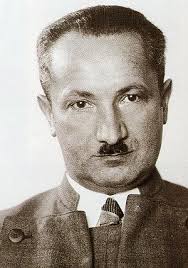
Corbin, Henry,
- “Le Thème de la
résurrection chez Mollâ Sadra Shirazi (1050/1640) commentateur
de Suhrawardi (586/1191)” in Studies in Mysticism and Religion
Presented to Gershom G. Scholem (Jerusalem, 1967), pp. 71-115.
*
- “Mollâ Sadra Shirazi”
in En Islam iranien, (Paris, 1972), Vol. IV, pp. 52-122.
*
-
En
Islam iranien, vol. IV, Paris, 1973.
-
"Histoire de la philosophie islamique, Ile Partie: Depuis la
morte d'Averroës jusqu'à nos jours", Encyclopédie de la Pléiade,
Histoire de la philosophie, Ile partie, Paris, 1974, pp.
1067-88.
-
`La
place de Mollā Sadra dans la philosophie iranienne', Studia
Islamica, vol. XVIII, pp. 81-113.
-
Le
Uvre des pénétrations métaphysiques, Tehran-Paris, 1964.
-
`Le
thème de la résurrection chez Mollā Sadrā Shīrāzī (1050/1640)
commentateur de Sohrawardî (587/1191)", in Studies in Mysticism
and Religion presented to Gershom G. Schalem, Jerusalem, 1967,
pp. 71-115.
-
Terre
celeste et corps de résurrection d'après quelques traditions
iraniennes, Paris, 1961.
Corbin, H.
+ Ãshtiyanî, SJ.,
Dagheim, Samih

- Mawsu`at Mustalahat Ṣadr al-Dīn
Shīrazī (Eng. title = `Encyclopedia of Sadr al-Din al-Shirazi's
Terminology'), 2 vols. Dharwa al-Qurbi, 1428/XXXX, lxiii680+681-1250
+ Indexes pp.1251-1423pp.
*
Dakake , Maria Massi
- `The Soul as Barzakh:
Substantial Motion and Mullā Sadrā's Theory of Human Becoming '
in The Muslim World, vol. 94/ 1 (2004) pp. 107 ?
Fakhry, Majid,
- Islamic Occasionalim
and its Critique by Averroes and Aquinas. London: George Allen &
Unwin Ltd., 1958.
- ‘The Concept of
Perpetual Creation in Islamic Mysticism and Zen Buddhism’ in
Mélanges Offerts a Henry Corbin ed. S. H. Nasr, Tehran: 1977.
Gobineau,
J. A. Comte de, (d. 1888).
Horten, M. (1874- d.
).
Ibrahimi, Nādir
- Mardi dar ta'yyid abadī
bar asās-i dustān-i zindagi-yi Mullā Sadra-yi Shirazi...
,
Tehran: Karim Khan Zand, 1375/1996.*
Iqbal, M.,
Izutsu, Toshihiko
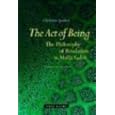
Jambet,
Christian and Jeff Fort (trans. from French)
Kalin,
Ibrahim (College of the Holy Cross, Worcester, MA. USA).
http://www.muslimphilosophy.com/kalin/index.html
-
“The
World Congress on Mulla Sadra”, American Journal of Islamic
Social Sciences Volume 16, No 3 (Fall 1999), pp.145-148;
reprinted in Iqbal Review Vol. 40, No. 3-4 (October, 1999),
107-110.
-
“Knowledge as the Unity of the Intellect and the Object of
Intellection in Islamic Philosophy: A Historical Survey from
Plato to Mulla Sadra”, Transcendent Philosophy: An International
Journal for Comparative Philosophy and Mysticism, Vol. 1, Number
1, (June 2000), pp. 73-91; also published in Seyed Safavi (ed.),
Perception According to Mulla Sadra, Salman-Azadeh Publication,
n.p., 2002, pp. 74-99.
-
“Sadr
al-Din al-Shirazi (Mulla Sadra)”, Center for Islam and Science,
Resources on Islam and Science at www.cis-ca.org (posted in
March 2001).
-
`An
annotated bibliography of the works of Mullā Sadrā with a brief
account of his life' in Islamic studies, 42
(2003) pp. 11ff.
-
`Mullā
Sadrā's realist ontology of the intelligibles and Theory of
Knowledge' in The Muslim world 94 (2004),pp. 81-106.
-
`Mulla
Sadra’s Realist Ontology and the Concept of Knowledge' The
Muslim World, Vol 94, No 1 (January 2004), pp. 81-106.
-
“Why
Do Animals Eat Other Animals? Mulla Sadra on the Best of All
Possible Worlds” Turkish Journal of Islamic Studies, Vol. 12
(June, 2004) (forthcoming).
-
“Between Physics and Metaphysics: Mulla Sadra on Nature and
Motion” Islam and Science Vol. I, 2003, pp. 65-93; an earlier
version published in Mulla Sadra and Transcendent Philosophy:
Proceedings of the World Congress on Mulla Sadra (Tehran: Sadra
Islamic Philosophy Research Institute, 2001), Vol. 1, pp.
301-327.
-
`Mullā
Ṣadrā on Theodicy and the Best of All Possible Worlds' in
Journal of Islamic Studies, Vol. 18, No. 2 May 2007,
pp.
Abstract
"The argument
that the world that God has created is the best of all possible
world-orders (asan al-nim) is based on the premise that God
always acts optimally. As a response to the problem of evil, the
argument seeks to remove any tensions between the imperfection
of the world and God's power and goodness. ar al-Dn al-Shirz,
known commonly as Mulla Sadr (d. 1640), develops a number of
arguments to defend the thesis as formulated by al-Ghazl. While
reiterating the previous arguments, Mull adr revises the
question of theodicy within the context of his concept of
existence and its modalities. Instead of discussing the problem
of evil in terms of moral imperfections alone, he defines the
world of existence as ‘that which is necessarily less than God’
and thus bound to be imperfect. Furthermore, Mull adr interprets
all evil, natural or moral, as serving a higher purpose because
the world is structured in a hierarchical way and for everything
there is a teleological history. The article looks critically at
the eight arguments which adr advances to defend his position.
At the end of his elaborate discussions, however, adr takes
refuge in blessed ignorance and faithfully accepts that not all
problems of philosophy can be solved decisively. "
Lumbard,
Joseph.
-
`The
place of prophecy in Mulla Sadra's philosophy of perception'
in Transcendent Philosophy, 2000, Vol. 1/ii, 63-79.
Moris,
Zailan,
Mulla
Sadra Comm. vol.
James W .
Morris (Review)
-
Revelation, Intellectual Intuition and Reason in the Philosophy
of Mulla Sadra: An Analysis of the al-Hikmah al-Arshiyya. • By
ZAILAN MORIS (London: Routledge Curzon, 2003), 238 pp.
Journal of Islamic Studies 2005 16. pp. 360-362
Nasr,
Seyyed Hossein.,
-
English introduction to Sadr al-Dīn Shīrāzī, al-Mabda'
wa'l-ma'ad ed. by S.J. Ashtiyanî, Tehran, 1976.
-
English introduction to Sadr al-Dln Shïra/î, Three Treatises,
ed. by S.J. Ashtiyani, Meshed, 1392/1973.
-
English preface to Sadr al-Dīn Shīrāzī, al-Shawähid al-rubũbiyyah,
ed. by S.J. Ashtiyani, Meshed, 1967.
-
`Mullā
Sadrā and the Doctrine of the Unity of Being', Philosophical
Forum, vol. IV, no. 1 Fall, 1972, pp. 153-61.
-
`Mullā
Sadra as a Source for the History of Muslim Philosophy". Islamic
Studies, vol. Ill, no. 3, Sept., 1964, pp. 309-14.
-
(ed.),
Mullā Sadrā Commemoration Volume, Tehran, 1380/1961.
-
`Mullā
Sadrā'in The Encyclopedia of Philosophy, vol. 5, New York, 1966,
pp. 411-13.
-
`Şadr
al-Dīn Shīrāzī, His Life, Doctrine and Significance', Indo-Iranica,
vol. XIV, no. 4, Dec. 1961, pp. 6-16.
-
`Sadr
al-Dīn Shīrazi 'Mullā Sadra' ', in Sharif, M. M., (ed.),A
History of Muslim Philosophy, vol. II, Wiesbaden, 1966, pp.
932-61.
-
1978. Sadr al-Din Shirazi and His
Transcendent Theosophy: Background, Life and Works, Tehran: Imperial
Academy of Philosophy.
-
1996 'Mulla Sadra: His
Teachings', in S.H. Nasr and O. Leaman (eds) History of Islamic
Philosophy, London: Routledge, 643-52.
- Mulla Sadra and His
Transcendent Philosophy (Tehran: 1997, 2nd edition).
- “Mulla Sadra: His
Teachings” in A History of Islamic Philosophy ed. by S. H. Nasr
and O. Leaman (London: Routledge, 1996), Vol. I, pp. 643-662.
- “Mulla Sadra as
a Source For the History of Islamic Philosophy” Islamic Studies,
3:3 (1964), 309-314.
- “Mulla Sadra” The
Encyclopedia of Philosophy, Paul Edwards (Editor in chief),
Vol.5 (New York: The Macmillan Company and The Free Press,
1967), pp. 411-413.
- (ed.) Mulla Sadra
Commemoration Volume Tehran, XXXX.,1380/1960.
- “Sadr al-Din al-Shirazi
(Mulla Sadra)” in A History of Muslim Philosophy, ed. M. M.
Sharif, (Wiesbaden: 1962).
Nelson,
Jim and Sada Georges Hormuz
Rahman, Fazlur.
-
1975 The Philosophy of Mulla Sadr (Sadr
al-Din al-Shirazi), Albany, NY: State University of New York Press.
-
The Philosophy of Mullā Sadra. Albany, N.Y.: SUNY Press, 1976.
-
2009
The Philosophy of Mulla Sadr (Sadr
al-Din al-Shirazi), New York: State University of New York Press,
2009. 277 pp. ISBN-10: 0791458520 ISBN-13: 978-0791458525
- Prophecy in Islam:
Philosophy and Orthodoxy. Chicago: University of Chicago Press,
1979.
- Essence and Existence
in Avicenna. Vol. 4, Medieval and Renaisance Studies. London:
Warburg Institute, 1958.
-
"The
Eternity of the World and the Heavenly Bodies in Post-Avicennian
Philosophy", in Houráni, G. (ed.), Essays on Islamic Philosophy
and Science, Albany (New York), 1975, pp. 322-37.
-
-
"The
God-World Relationship in Mullā Sadra", in Houráni, G., (ed.),
Essays on Islamic Philosophy and Science, Albany (New York),
1975, pp. 238-53.
-
"Mullā
Sadrā's Theory of Knowledge", Philosophical Forum, vol. IV, no.
1, Fall, 1972, pp. 141-52.
-
- ‘Mulla Sadra’
Encyclopedia of Religion, Vol. 10, (New York: 1987), 149-153.
- ‘Mir Damad’s Concept
of Huduth Dahri: A Contribution to the Study of God-World
Relationship Theories in Safavid Iran’ Near Eastern Studies 39
(1980), 139-151.
- 'Essence and
Existence in Avicenna' Mediaeval and Renaissance Studies, IV
(1958), 1-16
Rizvi, Sajjad
Haydar.
-
Reconsidering the Life of Mulla Sadra Shirazi (d. 1641): Notes
towards an Intellectual Biography... in IRAN XL (2002), 181-201.
-
`Mulla
Sadra and Causation: Rethinking a Problem in Later Islamic
Philosophy' in Philosophy East and West 55 No. 4 (2005),
570-583
-
`Mullā
Sadrā Shīrāzī : his life and works and the sources for Safavid
philosophy'. Oxford : Oxford University Press on behalf of the
University of Manchester, 2007. viii, 191 pp. (=
SERIES Journal of Semitic studies. Supplement ; 18). ISBN
0199297428. / ISBN 9780199297429.
Product
Description
"Mulla Sadra Shirazi is the first
attempt in English to produce a thorough preparatory study of
the intellectual biography of this famous Safavid thinker.
Previous attempts by other thinkers have been marred by
ideological prejudice and the lack of serious intellectual
rigour. A proper understanding of Islamic intellectual history
requires the study of canonical thinkers, of which Mulla Sadra
is certainly one in the philosophical tradition of Iran. The
book eschews legends and theoretical constructs of bibliography
in favour of a rigorous life that draws upon a wide range of
primary sources, many of which are unpublished, and that
demonstrate the significance and context of the intellectual
contributions of Mulla Sadra. Mulla Sadra Shirazi is quite a
traditional biography in that it seeks to locate the life of the
thinker and his works in his historical and intellectual
content. The course of ideas in Islam is an area of research
that is of great interest at the moment; even the study of
philosophy has flourished in recent years. Consistently, with
recent works on other Islamic philosophers, this book sets the
standard for approaching Islamic intellectual history by
insisting upon an historical and source-critical approach,
allied with a keen philological, but also philosophical,
appreciation of the intellectual life of a thinker. The life is
based upon the most recent scholarship on Safavid history and
draws widely upon primary sources in Arabic and Persian,
including a number of works in manuscript. For students of
Islamic thought in the early modern period and those with a
particular interest in philosophy in Safavid Iran, this book
should be the first point of reference. Mulla Sadra Shirazi will
become the foundation for further research both on Mulla Sadra
and his thought, as well as the thought and intellectual trends
of his period."
-
-
Mulla
Sadra and Metaphysics (Culture and Civilization in the Middle
East) by Sajjad H. Rizvi, 2009.
Sabahuddin,
Abdur Rahman,
-
"Mullā
Sadrā", Indo-Iranica, vol. XIV, no. 4, Dec. 1961, pp. 17-29.
Sells,
Michael.
-
Mullā
Ṣadrā (Ṣadr al-Din Shirazi) in `Great Thinkers of the
Eastern World. The major thinkers and the philosophical and
religious classics of China, India, Japan, Korea, and the world
of Islam' . Ed. Ian P. McGreal. XXXX: Harper Collins
Publishers, ADD, pp. 484-488.
Tabrizi, Ja`far Sajjadi
- Hastī Shināsī dar Maktab-i Sadr-i Muta'alihin
(Ontology in Sadr al-Din Shirazi's school). Tehran: Kitābkhānah-yi
Millī-yi Iran (= Institute for Humanities and Cultural
Studies) 1398/ 1977 + 2nd ed. 1400/1979..
*
Tabrizi, Ja`far Subhani
- Hastī Shināsī dar Maktab-i Sadr-i Muta'alihin
(Ontology in Sadr al-Din Shirazi's school). Tehran: Kitābkhānah-yi
Millī-yi Iran (= Institute for Humanities and Cultural
Studies) 1398/ 1977 + 2nd ed. 1400/1979..
*
Yusuf, K.M.,
-
"Iran
Society celebrates the Quadringenary of Mullā Sadrā", Indo-Iranica,
vol. XIV, no. 4, Dec. 1961, pp.1-5.
Ziai, Hossein.
-
1996 'Mulla Sadra: His Life and
Works', in S.H. Nasr and O. Leaman (eds) History of Islamic Philosophy (London: Routledge) 635-42.
-
"Beyond Philosophy: Suhrawardi's Illuminationist Path to
Wisdom," in Myth and Philosophy, ed. Frank E. Reynolds and David
Tracy, New York, 1990a, pp. 215-43.
-
Knowledge and Illumination: A Study of Sohravardi's Hikmat al-Ishrăq,
Atlanta, 1990Ե.
-
"Mošāheda. raveš֊e ešraq, wa zabān-e še'r," Irān-nāmailran Nameh
8/1, Winter 1990e, pp. 81-94.
-
"The
Manuscript of al-Sajara al-elahiya, a Philosophical Encyclopedia
by Šams-al-Din Šahrazuri." Iranšenasillranshenasi 2/1, Spring
1990d, pp. 89-108.
-
"Sohravardi wa siāsat." Irān-nāma/Iran Nameh 9/3, Summer 1991.
pp. 396-410.
-
"Source and Nature of Authority: A Study of Suhrawardi's
Illuminationist Political Doctrine," in The Political Aspects of
Islamic Philosophy. ed. Charles Butterworth, Cambridge, Mass.,
1992a. pp. 304-44.
-
Ta'rifwa mabāni-e šenākt dar f al safa֊ ye ešraq (Definition and
the foundations of knowledge in Illuminationist philosophy),
section on al-aqwal al-šāreha from the unpublished text al-Masare'
wa'l-motãrahãt, in Borhān Ebn Yousef, ed. Jaśn-nama-ye 'Ostad
Jawãd Mosleh,
Los Angeles, 1993. pp. 108-30.
-
"The
Illuminationist Tradition" and "Shihab al-Din Yalıya
Suhrawardi," in The Routledge History of Islamic Philosophy,
eds. S. H. Nasr and Oliver Lea-man, London, 1995, pp. 434-64 and
465-96.
-
"al-Suhrawardi, Shihab al-Din." in El՝՜ IX. 1997. pp. 782-84.
-
"Illuminationist Philosophy." in The Routledge Encyclopedia of
Philosophy \\. ed. Eduard Graig, London, 1998b, pp. 700-703.
-
Suhrawardi's The Book of Radiance 'forrou• \amehi. a parallel
English Persian text. ed. and tr. with introd.. Costa [page 1]
Mesa, 1998c.
-
+
Ahmad Alwishah, Studies in Medieval Physics: Ibn Kammuna's al-Tanqihatfi
Shark al-Talwihat. Costa Mesa. 2003.
-
+ John
Walbridge. The Philosophy of Illumination. English tr. of Suhrawardi's Hikmat al-Ishraq, plus a new critical ed. of the
Arabic text, with introd., notes, and glossaries of technical
terms, 2000.
-
-
`Illuminationism'
in EIr. vol. XII/6-p. 671f+ XIII/1 pp.1-2.
-
________________________________
|

